(Phys.org) —A team of chemists from the Chinese Academy of Sciences in Beijing has created an alternative to carbon nanotubes. In their paper published in the journal Advanced Materials, the researchers describe how they built a supramolecular yarn from monomers that is as strong as polypropylene, a common plastic.
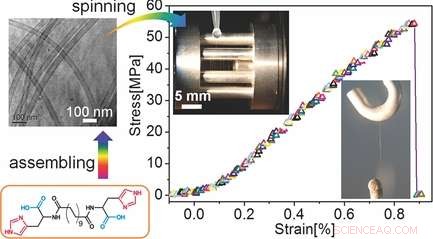
Because of the myriad ways they can be used, scientists have dedicated a lot of effort to creating yarn-like materials that are strong, soft, flexible and can be created in virtually any length. Carbon nanotubes have been the focus of a lot of that research, and for good reason—scientists believe they may one day form the basis of such exotic structures as a space elevator. But that day hasn't yet arrived, and for that reason, researchers continue to look at other materials that may prove just as useful. In this new effort, the research team in China has discovered a way to make yarn out of carbon and other monomers that form threads that combine to form a type of yarn when pulled or spun.
The threads were made by mixing monomers (molecules that bind chemically with other molecules) to form threads made of carbon with histidine (an amino acid) serving as the handles on either end. They found the threads formed into flat paper-like materials when submersed in an alkaline solution which then spontaneously rolled themselves up into tubes—each just 40nm in diameter. They also found that if they poked a pin into the solution and then slowly pulled it back out again, the material could be drawn out into a continuous thread which could then be intertwined to form a yarn-like material. When using a spinning spool, the researchers found they could extract yarn segments as long as several meters. After drying, the researchers found the yarn was approximately the same strength as ordinary plastics.
Because the individual threads are so small (and bio friendly) the team envisions micro based research efforts using the threads as platforms for growing cells and possibly even being used to help restore functionally to people with nerve damage. The team plans to further their research to determine if they can build other types of yarns using the same basic technique.
© 2013 Phys.org