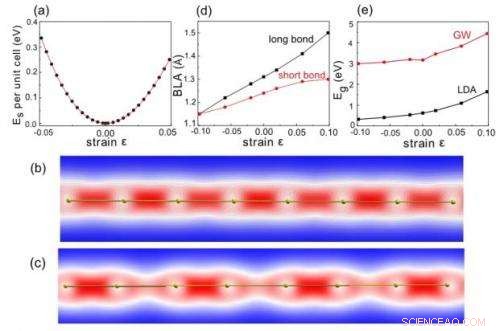
Carbyne under tension. (a) DFT calculations of energy as a function of strain ɛ. The electronic density of carbyne (polyyne) (b) in equilibrium and (c) under tension shows a more pronounced bond alternation in strained carbyne. (d) Bond length alternation and (e) band gap increase as a function of strain. Credit: arXiv:1308.2258 [cond-mat.mtrl-sci]
(Phys.org) —A paper on Arxiv presents a detailed look at the properties of carbyne, stronger than graphene and diamond, a true supermaterial. The paper is titled, "Carbyne from first principles: Chain of C atoms, a nanorod or a nanorope?" Authors are Mingjie Liu, Vasilii I. Artyukhov, Hoonkyung Lee, Fangbo Xu, and Boris I. Yakobson, from Rice University, in Houston, from the departments of mechanical engineering and materials science, chemistry, and the Smalley Institute for Nanoscale Science and Technology. They have calculated the properties of carbyne. Described as a chain of carbon atoms that are linked by alternate triple and single bonds or by consecutive double bonds, carbyne is of special interest, chemists find, because it is stronger, and stiffer than anything that they have seen before. The discovery of carbyne is not entirely new. Explorations of carbyne have their own history.
Indications of naturally-formed carbyne were observed in such environments as shock-compressed graphite, interstellar dust, and meteorites, said the authors. Recently, chains with length of up to 44 atoms have been chemically synthesized in solution.
Elsewhere, a Rice University report on carbyne research in 2011 said that while carbyne is considered an exotic material, recent experiments showed it can be synthesized and stabilized at room temperature, where the storage is mainly of interest.
Of special interest in the new paper on carbyne is that research by the Rice team indicates just how strong and stiff is this supermaterial. They were able to calculate its properties. In presenting a summary and conclusions of their research, the authors said that they were able to create a comprehensive portrait of carbyne. Some key points are as follows. It has an extreme tensile stiffness, stiffer by a factor of two than graphene and carbon nanotubes—and a specific strength surpassing that of any other known material. Its flexibility is between those of typical polymers and double-stranded DNA, they continued, with a persistence length of ~14 nm.
A combination of unusual mechanical and electronic properties, they said, is of great interest for applications in nanomechanical systems, opto-/electromechanical devices, strong and light materials for mechanical applications, or as high–specific-area energy storage matrices.
Their research was supported by the Robert Welch Foundation, a source of funding for chemistry research, and the Department of Energy.
© 2013 Phys.org