Credit: ACS
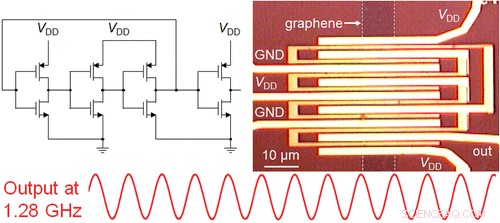
(Phys.org) —A research team with members from the U.S. and Italy has succeeded in building an integrated graphene digital circuit that is able to function at gigahertz frequencies. In their paper published in the journal ACS Nano, the team describes how they built their circuit, its performance, and its limitations.
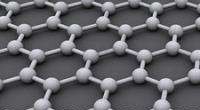
Researchers around the world continue to look to graphene as a means to overcome the size limitations of silicon—making circuits smaller than 10nm. Graphene is an ideal candidate because electrons can pass through the single layer of carbon atoms as if they had no mass. Unfortunately, graphene is not a semiconductor, thus other materials have to be included in a device to allow graphene to be used in a circuit. To date, efforts to do so have met with limited success—current leaks at the juncture points leading to poor performance.
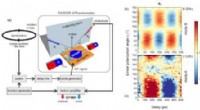
In this new effort, the researchers built a ring oscillator—a circuit used to evaluate the performance limits of digital electronic devices—based on graphene using a new technique (prior attempts by other teams to build such a device exhibited limited performance). To create a stronger connection between the graphene and other components, the team grew the graphene directly on them. Once all the pieces were in place, the team tested the device by applying electricity, slowly lowering the voltage. As they did so, the oscillation frequency increased—moving from 350MHz to 1.2GHz. Such a frequency is routine for silicon based devices but marks a new high point for those based on graphene.
In running their circuit, the researchers noted one feature of their device that was actually better than those based on silicon—performance wasn't degraded due to fluctuations in voltage. They also acknowledge that like other devices based on graphene, there was still too much current leakage and its speed was limited by resistance at the graphene and its substrate boundary. This means their graphene-based ring oscillator is not yet ready for the real world. Still, they believe their work has shown that graphene-based high frequency circuits can be made and that further work may reduce the resistance and lead to higher frequency graphene based circuits.
© 2013 Phys.org