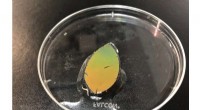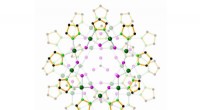
Image showing γ-Fe2 O3 nanocages. Credit: Taeghwan Hyeon]
(Phys.org) —A large team of researchers, most of which are based in Korea, has succeeded in extending the process of galvanic replacement reactions to ionic compounds. In their paper published in the journal Science, the team describes how they used preformed nanocrystals to serve as a template to produce hollow box-shaped nanocrystals.
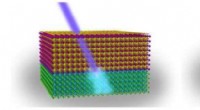
In the early days of nanomaterial research, chemists built environments for the creation of new nanocrystal-based materials using the proper mix of solvents, surfactants and molecular precursors. They then experimented with ways to cause the atoms in the mix to self assemble into the desired shape. More recently, researchers have found that a better way is to use preformed nanocrystals to serve as a template for the creation of new materials. Adding chemicals causes them to be changed in desired ways resulting in nanoparticles with unique properties. With metal nanocrystals, atomic exchange reactions can be brought about by taking advantage of the reduced potential differences between a metal in a template and metal ions in a solution—a method known as galvanic replacement. At its base, it's a process of atomic diffusion—atoms are caused to move away from a structure, creating vacancies. Until now, however, this method has been limited to metals. In this new effort, the galvanic replacement process is extended to ionic compounds.
To cause the galvanic replacement process to work with ionic compounds, the researchers used redox-couple reactions between multivalent metallic ions. More specifically, when they caused manganese oxide nanocrystals to react with iron percholate, a new type of nanocrystal was created in the form of hollow shaped boxes which eventually evolved into hollow crystals that resembled cages. Because of their shape, the researchers dubbed them "nanocages." The process works because higher-oxidation state ions in manganese are naturally replaced by lower-oxidation state ions in the solution.
The team's results demonstrate that ionic compounds can be easily and cheaply used as templates to create new and useful nanocrystal-based materials. Further research, they suggest, is likely to lead to nanomaterials creations that are limited only by the imagination.
For now, the researchers suggest the new type of nanocrystals might be useful in a wide variety of applications ranging from energy production, to biotechnology and electronics, and perhaps even as an anode material for lithium ion batteries.
© 2013 Phys.org