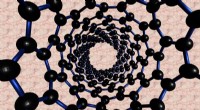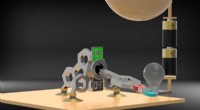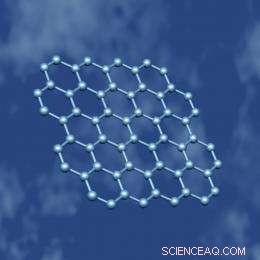
Artistic impression of graphene molecules. Credit: University of Manchester
(Phys.org) —Researchers at Queen's University have discovered a cheaper method for making a substance similar to graphene, a wonder material discovered in 2004.
Graphene is a single layer of carbon atoms, arranged in a lattice pattern, with a wide range of applications including mobile device screens, solar cells, aircraft components, hydrogen fuel cells and fast-charging lithium-ion batteries. The discovery by chemistry professor Suning Wang and her team allows for the creation of a material with properties similar to graphene at a much lower cost.
"Dr. Wang's elegant process creates a powerful tool to make graphene-based materials. These materials could potentially be used in a vast range of applications in the electronic, semiconductor, display, fuel cell, solar cell, sensing and imaging industries, to name just a few," says Lucy Su, Commercial Development Manager at PARTEQ Innovations, which filed for patent protection on the technology.
Graphene's revolutionary properties derive from its delicate structure, a single-atom-thick sheet of carbon atoms arranged in honeycomb lattices. Creating this ultra-thin honeycomb sheet is both tedious and difficult.
Dr. Wang and her team have created a simpler, greener "bottom-up" method that replaces some of the carbon atoms with boron and nitrogen. This enables them to "grow" graphene-like honeycomb lattices, simply by exposing the compounds to light.
"This discovery exemplifies ground-breaking research leading to transformative technological developments," says Steven Liss, Vice-Principal (Research). "Dr. Wang's discovery has not only led to more effective and efficient processes, but has improved sustainability and minimized environment impact."
Dr. Wang is an award-winning researcher specializing in organoboron chemistry and luminescent materials. Her team's discovery was ranked as "highly important" by the prominent international journal Angewandte Chemie.