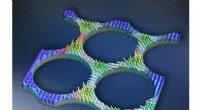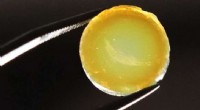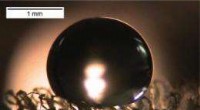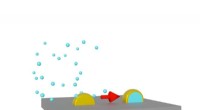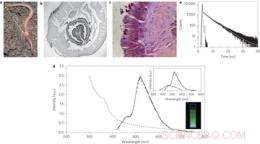
Schematics of the earthworm used and optical characterization of the quantum dots. Credit: (c) Nature Nanotechnology 8, 57–60 (2013) doi:10.1038/nnano.2012.232
(Phys.org)—British researchers at King's College in London have succeeded in creating quantum dots by feeding earthworms soil laced with certain metals and then collecting the material excreted. They describe their research in their paper published in the journal Nature Nanotechnology.
Quantum dots are nano-sized semiconducting materials with characteristics defined by their crystal shape. They are useful because of the unique way they emit or absorb light, similar in many respects to the florescence seen in some molecules. Thus far, their creation has proved to be useful in making LEDs, photovoltaic materials and very small lasers.
In this new research, the team set out to determine if common earthworms could be used to create cadmium telluride quantum dots. The thinking was that because earthworms are known for their detoxifying abilities – they do so by shuttling toxins into a special layer of their gut – they might be able to cause certain metals to combine as they are processed, creating nano-sized materials that qualified as quantum dots. In this case, they fed several earthworms soil with sodium tellurite and cadmium chloride mixed into it, for 11 days. Afterwards, they examined the material excreted by the worms in their tissue and found in detoxifying the metals, the worms had indeed created cadmium telluride quantum dots.
The creation of such quantum dots as part of a biological process leads to particles that are water soluble – that means that they might be put to use in biological settings. As one example, the researchers placed the worm-created quantum dots in a Petri dish along with cultured cancer cells obtained from mice. The cancer cells immediately absorbed the dots as was evidenced by shining UV light on them and witnessing their familiar green glow. In doing the same with other types of cells, the researchers found that it took some added manipulation to get them to soak up the dots, but in the end discovered it was possible.
The team notes that that their research provides two new pieces of useful information: one – it's possible to make quantum dots using worms, and possibly other organisms, and two – it's possible to make quantum dots that might prove useful in living tissue as part of a system of diagnostic tools.
© 2012 Phys.org