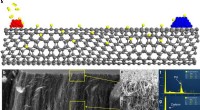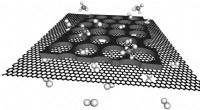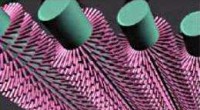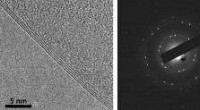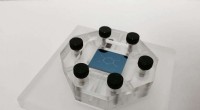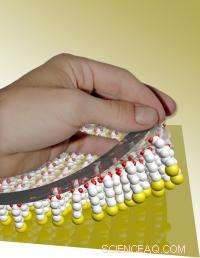
Reactive stamps remove molecules from surfaces to create precise nanoscale patterns. Credit: Kei Meguro, Sarawut Cheunkar, Paul Weiss, Anne Andrews, UCLA
(Phys.org)—The normal process for printing is centuries old, a piece of material such as wood is fashioned to look like the desired output, a letter of the alphabet, for example resulting in a stamp. Ink is then applied to the stamp and then the stamp is pressed on to something else, such as a piece of paper, resulting in the printing of the letter as the ink is left behind. Modern lithography is based on much the same principle, but now a new way has been found that appears to be cheaper. Instead of inking the stamp, the researchers from the University of California, as they describe in their paper published in the journal Science, ink the "paper" then have the stamp remove the parts of the ink that don't belong.
The researchers aren't using ink and paper, of course, instead they are using polydimethylsiloxane, gold and alkanethiols. A pattern was made in a piece of polydimethylsiloxane (a type of rubber), using an electron beam, i.e. photolithography, to create the stamp. They then covered a base of alkanethiols with gold, which served as the material to be printed on. Then to print the desired pattern, the stamp was applied to the base material, then removed, pulling with it (due to a reaction of the materials) not only the gold top layer, but the alkanethiols beneath, resulting in a pattern being left behind which could serve as either the end product itself or a receptacle for filling by another substance, such as protein molecules. Either way the result is a process that results in what the researchers describe as a high degree of resolution, because the material removed is molecule sized.
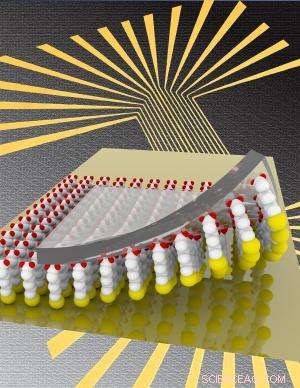
Credit: Sarawut Cheunkar, Paul Weiss, Anne Andrews, UCLA]
This new research came about as the chemists collaborated with neuroscientist Anne Andrews, who suggested that perhaps a way could be found to print materials onto surfaces in much the same way that neurotransmitters are "stamped" with biomolecules.
The down side is that despite achieving a resolution of 40nm, it still isn't enough for neurological work, so the team is looking into other ways to create the original stamp rather than using conventional photolithography, which at the nano level, causes some diffusion, and resultant blurring of the original image that is to be reproduced.
This new stamping technique is cheaper than conventional methods due to its subtractive, rather than additive nature, which means less waste and also appears to be easier to pull off, thus, it might lead to uses in other fields as well.
© 2012 Phys.org