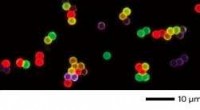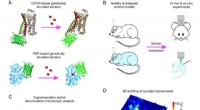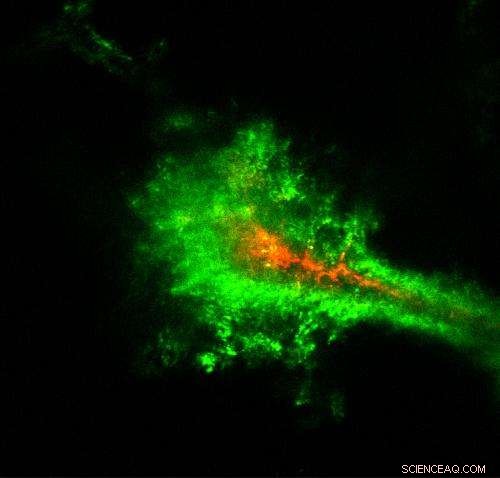
This image shows real-time imaging of nanoparticles (green) coated with polyethylene-glycol (PEG), a hydrophilic, non-toxic polymer, which penetrate within a normal rodent brain. Without the PEG coating, negatively charged, hydrophobic particles (red) of a similar size do not penetrate. Credit: Elizabeth Nance, Graeme Woodworth, Kurt Sailor
(Phys.org)—A new US study has found a way of enabling larger nanoparticles than previously to penetrate brain tissues, which may provide a new means of delivering therapeutic drugs to brain tissues for targeted treatment of conditions such as brain tumors and strokes.
A problem encountered when scientists have attempted to get nanoparticles into the brain is that the space between brain cells is sticky and too difficult for nanoparticles greater than 64 nanometers (nm) in diameter to get through. This limits the use of most nanoparticle drug delivery systems since the larger particles needed cannot effectively penetrate into the brain.
Researchers at Johns Hopkins University School of Medicine in Baltimore, led by Elizabeth Nance and Justin Hanes of the University's Department of Ophthalmology, experimented with nanoparticles of various sizes and coatings to try to find a way of enabling larger particles to diffuse within the brain.
The problem, Hanes said, is that the extracellular brain fluid is "very sticky," with similar adhesive qualities to mucus, and this impedes the spread of particles larger than 64 nm in diameter. The solution the group found was to densely coat the particles with polyethylene glycol (PEG). They discovered that when coated, nanoparticles as large as 114 nm could diffuse within fresh ex-vivo human brains. The team confirmed the findings with particles up to 100 nm in the brains of living mice and dissected rat brains.
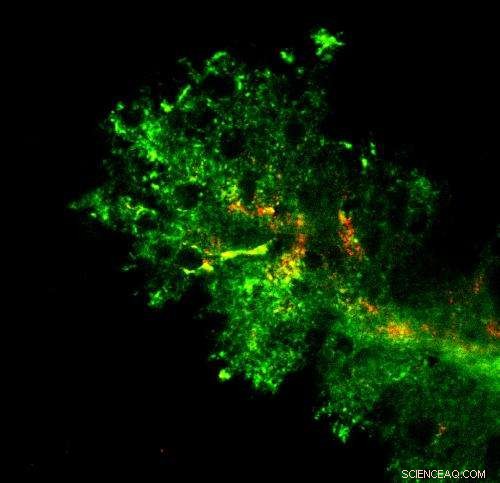
This image shows real-time imaging of nanoparticles (green) coated with poly(ethylene-glycol) (PEG), a hydrophilic, non-toxic polymer, show spread within a normal rodent brain. These particles can move through channels and regions between cells in the brain, indicated by dark circular spots in the image. Nanoparticles of a much larger size (red), also coated with PEG, are sterically hindered by the cells and components in the brain’s extracellular space, and do not penetrate far from the site of injection. Credit: Elizabeth Nance, Graeme Woodworth, Kurt Sailor
Polyethylene glycol is a low-toxicity polymer with a wide range of uses, including as a dispersant in toothpaste and skin creams, and as an anti-foaming agent in foods. As a coating for the nanoparticles, the PEG acts as a shield against hydrophobic and electrostatic interactions with the tissues and prevents the particles sticking to brain cells. At diameters over 114 nm, the particles begin to adhere, but Dr Hanes thinks the size limit could be as high as 200 nm.
The study's findings, published in Science Translational Medicine, may find application in more effective delivery of drugs to the brain tissues to treat conditions such as brain tumors, strokes and inflammation of the brain, but the researchers say that more research is needed on possible unwanted side effects or toxicity of drug-laden nanoparticles before clinical trials can begin.
© 2012 Phys.org