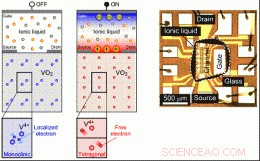
This is a schematic and an optical micrograph of a new transistor based on VO2 enabling electrical switching of the state of matter. Credit: RIKEN
(Phys.org) -- Engineers from several research organizations working together in Japan have developed a working prototype of a Mott transistor, a possible alternative to the standard silicon based field-effect transistor (FET). The prototype, as the team describes in their paper published in the journal Nature, used a new type of material, called a Mott insulator that changes from a resistor to a metal when an electric charge is introduced.
Modern electronics is based on FETs that are generally put together as a three layer sandwich; the surface of the top layer serves as a semiconductor for the electric charge sent through the middle layer, while the bottom layer serves as a base. In this setup, voltage sent through a channel increases the conductivity of the semiconducting material allowing the electricity to move between a source and drain. The net result is a device that can operate as either a gate or a switch. But because the switching mechanism is limited to just the surface of the semiconducting material, researchers have been on a quest to find a material that can do the same throughout its entire body, allowing more electrons to move all at the same time. This new team of researchers believes they may have found it.
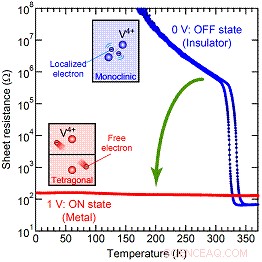
This shows the emperature dependence of the sheet resistance of VO2 in ON and OFF states. Just one volt is enough to switch ON and OFF states. Credit: RIKEN
In their lab, the researchers coated a piece of vanadium dioxide, a known Mott insulator, with a tiny bit of ionic liquid and then applied a single volt of electricity. That miniscule jolt caused not just the surface of the material to change from an insulator to a conductor, but the whole chunk. That’s what Mott insulators do, but until now, no one had been able to figure out how to cause it to come about in a controlled way in a transistor.
Unfortunately, no one really understands how or why Mott insulators change from insulators to conductors the way they do and using an ionic liquid to assist the process wouldn’t be practical in a commercial transistor, which means we won’t be seeing such transistors introduced in products for sale anytime soon. Much more research still needs to be done, but the news that a prototype has been developed shows that in certain circumstances, Mott insulators can be made to work in a transistor and if other ways can be made to cause it to work, new voltage tunable transistors could be created or perhaps remote transmission of electricity devices might be developed.
© 2012 Phys.org