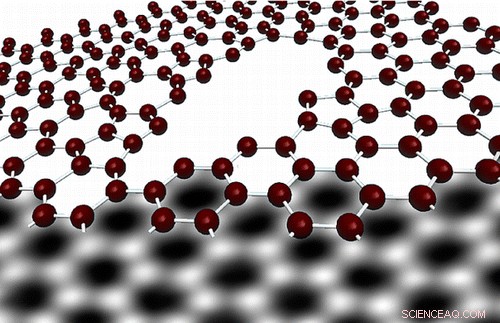
(Phys.org) -- Graphene, the one carbon atom thick sheet material has been in the news so much over the past couple of years it would seem that a saturation point has been reached. But then along comes another new discovery that is not only newsworthy, but offers hope that one day soon scientists will be able to figure out a way to mass produce the stuff allowing the full potential of the “miracle” material to finally emerge. The new discovery has been made by a team at the University of Manchester, one of whose members include Konstantin Novoselov, co-winner of the Nobel Prize for his work in discovering graphene. The team has found that when holes are made in a graphene sheet, if carbon atoms are brought near, they will be snapped up by the graphene sheet, repairing the hole and returning the sheet to its original properties. A paper written by the team was first uploaded to the preprint server arXiv, then shortly thereafter was published in Nano Letters.
Researchers have been excited about graphene because it offers so much promise in such a wide variety of applications ranging from electronics to advanced computers to medical applications. What’s been holding back the development of applications that can take advantage of its special properties though, has been the difficulty in mass producing it; being just one atom thick it tends to break easily and curl up into a ball. Because of this, a lot of research has been going on trying to figure out a way to get around both problems, and that’s exactly what the research team at Manchester was doing when they discovered a new surprising property; graphene can heal itself under the right conditions.
The team used a combination of an electron beam and metals such as palladium or nickel to create tiny stable holes (to attach electrodes) in a sheet of graphene that had been previously grown. In so doing they found that adding more metal allowed them to make larger holes that would remain stable, a significant find itself. But then, when they added carbon to the mix, they found that the carbon atoms displaced the metal and in the process caused the hole to be sealed, effectively returning the sheet to its original pristine condition. The researchers also found that if they used a hydrocarbon, the hole was sealed as well, but left a bumpy scar.
The teams’ results offer more than just a surprise, because at this juncture it seems possible that by manipulating this newly found property (such as using it as part of the growth process), a way might be found to mass produce the material, finally unleashing its full potential.
© 2012 Phys.org