Image: Nature, doi:10.1038/nnano.2011.235
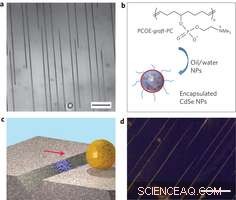
(PhysOrg.com) -- Imagine if instead of relying on special x-ray or electrical current testing technology to find really tiny cracks in the skin that covers an airplane, microcapsules filled with easily detected materials could be rolled around on their surface, stopping here and there to fill such cracks automatically so that they could then be easily found using a simple black light. That day may be coming soon, thanks to a joint effort between two teams. One, from the University of Pittsburgh, led by Anna Balazs, the other from the University of Massachusetts, led by Todd Emrick. Together they have created just such a type of capsule, as will be described in their paper to be published in Nature Nanotechnology.
It all started apparently, with Balazs creating computer models of small capsules containing nanoparticles that could under the right conditions, be made to unload their contents into small cracks or defects in certain surfaces. From there, the two teams worked together to port the model to the real world. The capsule they created is made of a very thin type of polymer that lowers the surface tension of a liquid and causes oil droplets to stabilize in water. Inside the capsule, they put cadmium-selenide nanoparticles. The resultant product was a microcapsule that would roll around or in some cases slide when placed on a hard surface and tilted about.
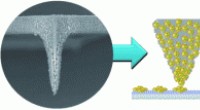
But of course, that was only the beginning. When the capsule they’d made happened to encounter a crack in the surface, it was stopped just as would a marble rolling into a crack in the sidewalk. But, then, because of the material used to make the walls of the capsule and the way the nanoparticles were prepared, hydrophobic interactions occurred causing the transfer of cadmium-selenide to the crack. Once that was done, the capsule was once again ready for rolling around and falling into other cracks. Afterwards, because cadmium-selenide just happens to be fluorescent, cracks in the material were easily found using an optical microscope.
This is clearly a brilliant idea. Why go to all the painstaking work of using human, error-prone techniques to find nearly invisible cracks in such surfaces as airplane exteriors, electronics and maybe even human implants, when rolling capsules could do the work for you. Also, the same technique could conceivably be used to find cracks and then repair them that are now fixed by coating the entire surface, thus saving a lot in maintenance costs.
© 2011 PhysOrg.com