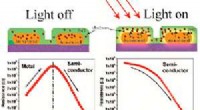
(PhysOrg.com) -- Researchers working at Cal Tech, have taken an idea first proposed by Koray Aydin, now at Northwestern and have created a new nanostructure that appears to be capable of absorbing light of any polarization and virtually any angle. The new “plasmonic” material has thus far shown it can convert light into heat, and holds promise for improving the efficiency of solar cells. The team, led by Harry Atwater has published their findings in Nature Communications.
Researchers have been working hard for several years to improve the efficiency of solar panels, because doing so would drive down costs, which so far have not been enough to allow solar cells to compete with fossil fuels. The problem is that current solar cells are based on silicon which is somewhat expensive to manufacture. Efforts to reduce the amount used in solar cells have resulted in lower efficiencies, and so are not really viable. Now however, it appears a different way to approach the problem might be at hand. The new material created by the Cal Tech team, because it absorbs more light, could be laid over conventional solar panels making them far more efficient. This means the silicon in them could be made thinner and the cells would still be more efficient than what is currently available. All because the new material is able to absorb more of the light that strikes it due to a scattering effect that it causes.
The new material is made of silver and is shaped into rows of trapezoids with a variety of bumps along the edges of various shapes and lengths to cause the light to bend in diverse ways. The result is a material that is able to absorb up to 70% of light across the visible spectrum. To make it polarization independent, they laid an identical sheet of the material across the first at a 90° angle.
By absorbing more light, the new material is able to convert the same amount of light shining on the material into more heat than other materials. The next step is in figuring out how to convert that extra absorbed light to more electricity and to do so with different kinds of materials, and that is just what Aydin and Atwater are working on together.
© 2011 PhysOrg.com