(PhysOrg.com) -- Michael Tsapatsis and colleagues at the University of Minnesota have devised a means for overcoming the problem of grouping that occurs during the exfoliation stage when producing zeolites which results in deformed structures in the framework which then leads to holes in the material that are larger than the pores needed to capture whatever is being filtered. The team has published its results in Science.
Zeolites are materials that are traditionally used as absorbents, but can also be used as a sieve or filter to separate or collect materials found in other materials. In the case of very small materials, scientists would like to create very small sieves to separate molecules from one another. Unfortunately, thus far, their efforts to create so-called zeolite nanosheets have proved rather fruitless as the processes used so far tend to result in the creation of holes in the sheet that are too large to capture the desire molecules.
The approach up to now has involved making layered zeolites silicate and its other component, ITQ-1, then blending the two by melting them together. The result is a nanocomposite that has two unique kinds of nanosheets called MWW and MFI. It’s at this stage where things go wrong. To get the zeolites, the polystyrene in the mix must be removed and attempts to do so have resulted in bent or curled sheets, which won’t work because it causes grouping or bunching which results in the development of holes that aren’t of the desired size.
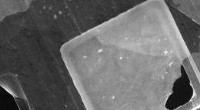
Tsapatsis and his team used the first process but went another way with the second. To separate out the polystyrene, they used sound waves in the water soluble liquid toluene and a centrifuge and wound up with flaky crystal type nanosheets that are not only flat, but have just the right amount of thickness.
The resultant product can be used to separate molecules as a sieve or as a membrane barrier in both research and industrial applications and Tsapatsis writes that he believes the same process can be used to create other types of zeolites, though he can’t say with any confidence how effective they may actually be. As always, further research will have to be done to find out.
© 2011 PhysOrg.com