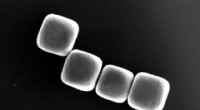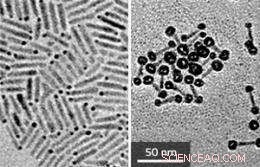
Transmission electron microscopy images of (left) CdSe-seeded CdS nanorods with palladium-gold tips (dark spots), and (right) CdS nanorods with core-shell gold-iron tip structures. Credit: 2011 ACS
Quantum dots are tiny semiconductor crystals that emit bright and tunable fluorescence. They are typically made of cadmium sulfide (CdS) or cadmium selenide (CdSe), and have a wide range of applications, including bioimaging and solar cells. Recently, chemists have sought to add new capabilities to quantum dots by fusing them with metal atoms, creating ‘heterostructured’ nanocrystals. However, bonding metal cations to a semiconductor often requires strong reducing agents—electron-donating chemical reagents that can play havoc with the quantum dot’s nanostructure.
Yinthai Chan and co-workers at the A*STAR Institute of Materials Research and Engineering and the National University of Singapore have now developed a technique that makes depositing metals onto semiconductor nanoparticles easier than ever. By using ultraviolet light to activate special gold-tipped ‘nanorods’, the researchers have successfully incorporated catalytic palladium and magnetic iron atoms into heterostructured nanocrystals using mild reducing agents, paving the way for a diverse range of new quantum-dot applications.
The nanorods contain a ‘seed’ particle, a spherical CdSe quantum dot, surrounded by a cylindrical shell of CdS molecules, tens of nanometers long. Under the right conditions, the researchers found that the tips of these nanorods act as nucleation points for metal growth. Gold cations, for example, deposited spontaneously on one or both ends of the CdS rods because they could be easily transformed into crystalline atoms using a mild reducing agent. Less-reactive metal cations like palladium and iron, however, would not nucleate onto either the bare or gold-tipped nanorods with the use of mild reagents.
Chan and his co-workers realized that one way around this problem was to exploit the semiconductor’s sensitivity to light. Exposing this material to ultraviolet radiation produces a photogenerated electron and a positive ‘hole’ within the nanorod. Normally, these particles recombine within a fraction of a second, but the researchers believed that in the presence of a hole-scavenging molecule like ethanol, electrons could migrate to the gold tip and enhance its reductive capabilities. Experiments revealed that this hypothesis was correct—the photo-powered gold tips reacted with palladium cations to give a surprising alloyed nanostructure, while iron cations bonded to the nanorod with a core–shell organization (see image).
“This study shows that the light-activated transfer of an electron from a semiconductor to a gold tip can allow deposition of metals that ordinarily would not be easily reduced using mild conditions,” says Chan. The researchers are currently exploring how combinations of metal tips and different semiconductors can affect the efficiency of other photo-induced catalytic processes.