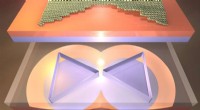
* Resolution Limits: Polarized optical microscopes rely on visible light for imaging. The resolution of light microscopes is limited by the wavelength of light, which is around 400-700 nanometers. Nanoparticles, with sizes typically below 100 nanometers, are much smaller than the wavelength of light. This means they are too small to be resolved individually by a traditional optical microscope.
* Diffraction: Even if a nanoparticle were slightly larger than the wavelength of light, its image would be blurred by diffraction. This is the phenomenon where light bends around an object, creating a fuzzy halo rather than a sharp outline.
Methods for Visualizing Nanoparticles:
To see nanoparticles, you need techniques with higher resolution than optical microscopy:
* Electron Microscopy: Transmission electron microscopy (TEM) and scanning electron microscopy (SEM) use electrons instead of light, providing much higher resolution (down to the atomic level). They are commonly used to image nanoparticles.
* Atomic Force Microscopy (AFM): This technique uses a sharp tip to scan a surface, revealing surface topography and can be used to image nanoparticles.
* Dynamic Light Scattering (DLS): While not directly visualizing nanoparticles, DLS measures the size distribution of particles in a solution by analyzing how they scatter light.
Polarized Light Microscopy Applications:
Polarized light microscopy is excellent for studying materials that interact with polarized light, revealing information about their structure and birefringence. It's often used for:
* Analyzing crystals: Identifying different crystal types based on how they interact with polarized light.
* Examining biological samples: Observing structures like muscle fibers, cell walls, and stress fibers in cells.
* Analyzing polymers and fibers: Determining the orientation of molecules in these materials.
In summary: While polarized light microscopy is a valuable tool for various applications, it is not suitable for visualizing the size and shape of nanoparticles due to resolution limitations. Specialized techniques like electron microscopy or atomic force microscopy are needed to image nanoparticles at the nanoscale.