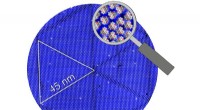
Nanotubes are tiny, cylindrical structures made of carbon atoms. They are so small that they can only be seen with an electron microscope. Electron microscopes use a beam of electrons to create an image of an object. The electrons bounce off the surface of the object and create a shadow. The shadow is then magnified and viewed on a screen.
When an electron beam hits a nanotube, the electrons are scattered in all directions. This is because the carbon atoms in the nanotube are arranged in a hexagonal pattern, and the electrons bounce off the atoms like they are hitting a trampoline. The scattered electrons create a halo around the nanotube. The halo is what makes the nanotube visible in the electron microscope.
The size of the halo depends on the diameter of the nanotube. The larger the diameter of the nanotube, the larger the halo. This is because the electrons have more room to scatter when they hit a larger nanotube.
Electron microscopes can be used to image nanotubes in both two and three dimensions. Two-dimensional images are created by scanning the electron beam across the surface of the nanotube. Three-dimensional images are created by taking a series of two-dimensional images at different angles.
Electron microscopy is a powerful tool for studying nanotubes. It can be used to determine the size, shape, and structure of nanotubes. Electron microscopy can also be used to study the properties of nanotubes, such as their electrical and thermal conductivity.