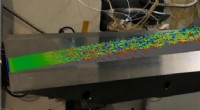
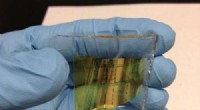
The movies are the creation of graduate student Joseph Romano from high-speed video images taken inside Hart’s electron microscope. They document for the first time how the shape of a carbon nanotube changes when it is bent, providing valuable new information for scientists seeking to understand the behavior of nanotubes and design new materials based on them.
“These are the first real-time observations of the bending of individual carbon nanotubes,” said Romano, who presented the research recently at the fall meeting of the Materials Research Society in Boston. “They are opening up a new avenue for exploring the properties of these remarkable materials.”
Carbon nanotubes are typically a few nanometers in diameter and can be several micrometers long. For comparison, the width of a human hair is about 50,000 nanometers. Due to their tiny size, carbon nanotubes have been studied primarily with atomic force microscopy and transmission electron microscopy, both of which provide static images rather than real-time videos.
Hart and Romano developed a new method for capturing video images of individual carbon nanotubes using an environmental scanning electron microscope (ESEM). The ESEM differs from a traditional scanning electron microscope in that it contains a tiny chamber filled with a low-pressure gas, in this case, water vapor. The gas provides enough resistance to the electron beam to prevent it from vaporizing the carbon nanotubes, allowing them to be imaged in real time.
To make a movie of a carbon nanotube bending, Romano suspended a nanotube across a tiny trench on a silicon chip and then used a precision manipulator to push on the nanotube. As the nanotube bent, Romano recorded video images of the process.
The movies reveal that carbon nanotubes bend in a unique way. When a guitar string is plucked, it vibrates at a specific frequency, producing a note. Similarly, when a carbon nanotube is bent, it vibrates at a specific frequency. The frequency depends on the length and thickness of the nanotube as well as the force applied to it.
By analyzing the movies, Romano was able to determine the Young’s modulus of carbon nanotubes, a measure of their stiffness. The Young’s modulus of the carbon nanotubes that Romano studied was found to be about 1 teraPascal (TPa), which is comparable to the Young’s modulus of diamond, the hardest material known.
The movies also provide new insights into the mechanical properties of carbon nanotubes. For example, they show that carbon nanotubes can withstand large amounts of bending without breaking, indicating that they are extremely tough.
The new research findings are expected to have implications for the design and application of carbon nanotube-based materials. For example, carbon nanotubes could be used to make ultra-strong fibers for use in lightweight materials or as sensors that detect the presence of specific chemicals.
“The potential applications of carbon nanotubes are enormous,” said Romano. “By understanding the mechanical properties of these materials, we can open the door to new and innovative applications.”