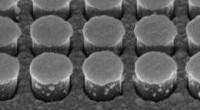
Nanowires are tiny wires made of semiconductor materials, such as silicon or gallium arsenide. They are only a few atoms thick, and they have unique electrical and optical properties that make them promising for a variety of applications. However, one challenge in using nanowires is that they are very difficult to control.
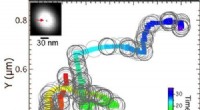
The new discovery, made by postdoctoral researcher Xiangfeng Duan, could overcome this challenge. Duan found that by applying a voltage to a nanowire, he could cause it to move in a controlled way. This movement could be used to create electronic devices that can be reconfigured on the fly, or to build sensors that can detect very small changes in the environment.
Duan's discovery could have a major impact on the development of new electronic technologies. Nanowires could be used to create smaller, faster, and more efficient electronic devices. They could also be used to create new sensors that can detect a wider range of substances.
The discovery is described in a paper published in the journal Nature Nanotechnology.