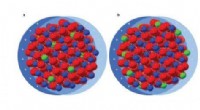
The body-centered cubic lattice is a structure in which each atom is surrounded by eight other atoms, one at each corner of a cube and one in the center of each face of the cube. This structure is more densely packed than the simple cubic lattice, in which each atom is surrounded by only six other atoms.
The difference in packing density between hard and soft spheres is significant. Hard spheres have a packing fraction of 0.524, while soft spheres have a packing fraction of 0.64. This means that soft spheres can pack almost 20% more densely than hard spheres.
The body-centered cubic lattice is not the only structure that soft spheres can form. They can also form other structures, such as the face-centered cubic lattice and the hexagonal close-packed lattice. The structure that a particular sample of soft spheres forms depends on the temperature, pressure, and other conditions.
The study of soft spheres is important for understanding a wide variety of phenomena, such as the behavior of colloidal suspensions and the properties of soft materials. Soft spheres are also used in a variety of applications, such as drug delivery and tissue engineering.