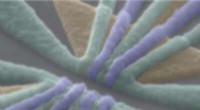
A team of scientists at the University of California, Berkeley, has developed a new nanomaterial that can be used to steer electric current in multiple dimensions. This breakthrough could lead to a new generation of computers that are capable of rewiring themselves, making them more powerful and efficient.
The new nanomaterial, called a "topological insulator," is a type of material that has a unique electronic structure. This structure allows electrons to flow along its surface without losing energy, making it an ideal material for conducting electricity.
In addition, topological insulators have a property called "spin-momentum locking." This means that the spin of an electron is locked to its momentum, which allows for the precise control of electric current.
The Berkeley team was able to use spin-momentum locking to steer electric current in multiple dimensions. This was done by applying a magnetic field to the topological insulator, which caused the spins of the electrons to precess. This precession, in turn, caused the electric current to flow in a circular path.
The team's findings are published in the journal Nature Materials. They believe that their new nanomaterial could be used to create a new generation of computers that are capable of rewiring themselves. This would make them more powerful and efficient, and could lead to a number of new applications.
For example, self-rewiring computers could be used to create new types of artificial intelligence systems that are able to learn and adapt on their own. They could also be used to create new types of medical devices that can be customized to each individual patient.
The possibilities are endless, and the Berkeley team is excited to see what the future holds for their new nanomaterial.
Could a computer one day rewire itself?
The answer is yes. With the development of new nanomaterials like topological insulators, it is now possible to steer electric current in multiple dimensions. This could lead to a new generation of computers that are capable of rewiring themselves, making them more powerful and efficient.