Metamaterials
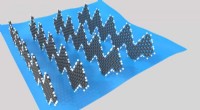
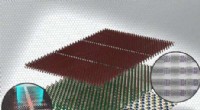
Metamaterials are composed of repeating patterns of tiny structures, such as metal nanoparticles or dielectric rods. These structures can be arranged in a way that controls the way light and other electromagnetic waves interact with the material. This allows metamaterials to be designed with specific properties, such as the ability to focus light, bend it around objects, or even make it invisible.
Metamaterials have a wide range of potential applications, including:
* Superlenses: Metamaterials can be used to create superlenses that can focus light beyond the diffraction limit, which is the fundamental limit of conventional lenses. This could enable the development of new microscopes and imaging devices with unprecedented resolution.
* Invisibility cloaks: Metamaterials could be used to create invisibility cloaks that make objects invisible to light. This could have a major impact on military and civilian applications, such as camouflage and surveillance.
* Antennas: Metamaterials can be used to create antennas that are smaller and more efficient than conventional antennas. This could lead to the development of new wireless devices with improved performance.
Quantum Dots
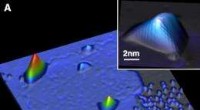
Quantum dots are tiny semiconductor particles that are only a few nanometers in size. These particles exhibit unique quantum mechanical effects, such as the ability to emit light of a specific color when excited by an external energy source. This makes quantum dots ideal for a variety of applications, including:
* Displays: Quantum dots can be used to create displays that are brighter, more colorful, and more energy-efficient than conventional displays.
* Solar cells: Quantum dots can be used to create solar cells that are more efficient at converting sunlight into electricity.
* Bioimaging: Quantum dots can be used as fluorescent markers to label and track cells and molecules in biological systems.
Quantum dots have the potential to revolutionize a wide range of technologies, from medical imaging to energy production.
Conclusion
Metamaterials and quantum dots are two emerging areas of nanotechnology with the potential to bring about major changes in a wide range of fields. These materials are still in their early stages of development, but they hold great promise for the future.