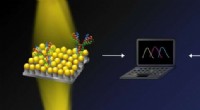
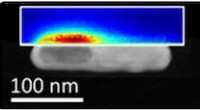
Resonant Absorption: Graphene nanostructures can exhibit resonant absorption of infrared light due to their plasmonic properties. Plasmons are collective oscillations of free electrons that can be excited by incident light of specific frequencies. When the frequency of infrared light matches the resonant frequency of graphene nanostructures, it leads to enhanced absorption. The resonant absorption can be further tuned by controlling the size, shape, and arrangement of graphene nanostructures.
Surface Plasmon Resonance: Surface plasmon resonance (SPR) is a phenomenon that occurs when infrared light interacts with metal-dielectric interfaces. Graphene, being a semi-metal, can also support SPR. When infrared light strikes a graphene nanostructure, it excites surface plasmons, which propagate along the graphene surface and interact with the incident light. This interaction leads to enhanced absorption and confinement of infrared light within the graphene nanostructure.
Interband Transitions: Graphene consists of a single layer of carbon atoms arranged in a hexagonal lattice. The electronic band structure of graphene exhibits a unique feature called the Dirac cone, which results in massless charge carriers. These charge carriers can be excited from the valence band to the conduction band by absorbing infrared photons. The interband transitions in graphene provide another mechanism for capturing infrared light.
Enhanced Light-Matter Interaction: The two-dimensional nature of graphene nanostructures allows for strong light-matter interaction. Graphene has a high surface area-to-volume ratio, which increases the probability of interaction between infrared light and graphene atoms. This enhanced light-matter interaction contributes to efficient absorption and capture of infrared radiation.
Tunable Properties: The properties of graphene nanostructures, such as their size, shape, doping level, and stacking configuration, can be tailored to optimize their interaction with infrared light. By engineering these parameters, it is possible to achieve selective and efficient capture of specific infrared wavelengths.
Combining these mechanisms, graphene nanostructures offer promising capabilities for capturing and utilizing infrared light in various applications, including thermal imaging, infrared sensing, energy harvesting, and optoelectronics.