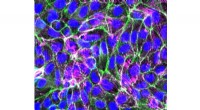
Cell migration is a fundamental process in biology that is involved in a wide range of activities, including embryonic development, wound healing, and immune response. During cell migration, cells extend protrusions in the direction of movement and then pull themselves forward using a process called traction force generation.
The researchers found that the curvature of a cell's surface plays a critical role in traction force generation. When the curvature of a cell's surface is high, the cell is able to generate more traction force and move faster. This is because the high curvature of the cell's surface allows it to make more contacts with the substrate and exert more force on it.
The researchers also found that the curvature of a cell's surface is regulated by a protein called Rac1. Rac1 is a small GTPase that is involved in a variety of cellular processes, including cell migration. When Rac1 is activated, it promotes the formation of protrusions on the cell's surface. These protrusions increase the curvature of the cell's surface and allow the cell to generate more traction force and move faster.
The findings of this study provide new insights into how cells move during development and disease. By understanding how the curvature of a cell's surface drives cell migration, researchers may be able to develop new treatments for diseases in which cell migration is impaired, such as cancer and wound healing disorders.
In addition to the potential implications for human health, the findings of this study could also have implications for the field of robotics. By understanding how cells move, engineers may be able to design robots that are able to move more efficiently and effectively.