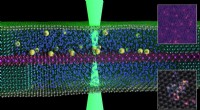
Quantum dots are tiny semiconductor particles that have unique optical and electronic properties. They are being studied for use in a variety of applications, such as solar cells, light-emitting diodes (LEDs), and lasers.
One of the challenges in using quantum dots is that they can blink, or emit light intermittently. This blinking can be caused by a variety of factors, including defects in the quantum dot material, the presence of impurities, and the temperature.
Argonne National Laboratory researcher Dr. Mariana Berciu is studying what causes quantum dots to blink. She is using a combination of experimental and theoretical techniques to investigate the mechanisms behind blinking. Her work could lead to the development of new ways to control and prevent blinking, which would make quantum dots more useful for a variety of applications.
Blinking quantum dots
Quantum dots are typically made of semiconductor materials, such as cadmium selenide (CdSe) or indium phosphide (InP). They are typically only a few nanometers in size, which is about 100,000 times smaller than the width of a human hair.
Due to their small size, quantum dots have unique optical and electronic properties. For example, they can emit light of different colors, depending on their size and composition. This property makes them promising candidates for use in a variety of applications, such as solar cells, LEDs, and lasers.
However, one of the challenges in using quantum dots is that they can blink, or emit light intermittently. This blinking can be caused by a variety of factors, including defects in the quantum dot material, the presence of impurities, and the temperature.
Dr. Mariana Berciu's research
Dr. Mariana Berciu is an Argonne National Laboratory researcher who is studying what causes quantum dots to blink. She is using a combination of experimental and theoretical techniques to investigate the mechanisms behind blinking.
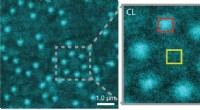
One of the experimental techniques that Dr. Berciu uses is photoluminescence spectroscopy. This technique involves shining a light on a quantum dot sample and measuring the light that is emitted. The emission spectrum can provide information about the energy levels of the quantum dot and the mechanisms behind blinking.
Another experimental technique that Dr. Berciu uses is time-resolved photoluminescence spectroscopy. This technique involves shining a pulsed laser on a quantum dot sample and measuring the light that is emitted over time. The time-resolved emission spectrum can provide information about the blinking dynamics of the quantum dot.
In addition to experimental techniques, Dr. Berciu also uses theoretical techniques to investigate the mechanisms behind blinking. She uses quantum mechanics to model the electronic structure of quantum dots and to calculate the rates of blinking.
Applications of Dr. Berciu's research
Dr. Berciu's research could lead to the development of new ways to control and prevent blinking. This would make quantum dots more useful for a variety of applications, such as solar cells, LEDs, and lasers.
For example, in solar cells, blinking can reduce the efficiency of the cell. By preventing blinking, it would be possible to increase the efficiency of solar cells and make them more cost-effective.
In LEDs, blinking can cause the light to flicker. By preventing blinking, it would be possible to create LEDs that emit a steady light.
In lasers, blinking can cause the laser to produce pulses of light instead of a continuous beam. By preventing blinking, it would be possible to create lasers that produce a continuous beam of light.
Dr. Berciu's research is helping to advance the understanding of quantum dots and their applications. Her work could lead to the development of new technologies that use quantum dots to improve the efficiency of solar cells, the performance of LEDs, and the reliability of lasers.