A new nanomaterial could one day allow computers to rewire themselves, making them more powerful and efficient. The material, called a "topological insulator," is able to conduct electricity in a way that is not affected by the surrounding environment. This means that it could be used to create circuits that are not affected by noise or interference, which could lead to faster and more reliable computers.
Topological insulators are a class of materials that have a unique band structure. In a normal insulator, the valence band (the highest energy band that electrons can occupy) is completely filled, while the conduction band (the lowest energy band that electrons can occupy) is empty. This means that electrons cannot move freely through the material, and so it is an insulator.
In a topological insulator, however, the valence band and the conduction band are inverted. This means that the valence band is partially filled, while the conduction band is partially empty. This creates a situation where electrons can move freely through the material, but only in certain directions.
The direction in which electrons can move is determined by the topology of the material. Topology is a branch of mathematics that studies the properties of objects that do not change when they are deformed. In the case of topological insulators, the topology of the material determines the direction in which electrons can move.
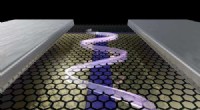
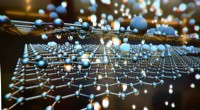
The new nanomaterial is a topological insulator that has been synthesized in a two-dimensional form. This means that it is only one atom thick. This makes it possible to create circuits that are very small and dense.
The researchers who developed the new material believe that it could be used to create a new generation of computers that are faster, more powerful, and more efficient than current computers. They are currently working on developing ways to use the material to create practical devices.
Could a computer one day rewire itself?
The new nanomaterial could one day allow computers to rewire themselves. This would be a major breakthrough, as it would allow computers to repair themselves and to adapt to new tasks.
Self-rewiring computers could be used for a variety of applications, such as:
* Medical diagnosis: Self-rewiring computers could be used to analyze medical data and to diagnose diseases.
* Drug discovery: Self-rewiring computers could be used to design new drugs and to test their effectiveness.
* Climate modeling: Self-rewiring computers could be used to create more accurate climate models.
* Space exploration: Self-rewiring computers could be used to control spacecraft and to analyze data from space missions.
The potential applications of self-rewiring computers are endless. If researchers are able to develop ways to use the new nanomaterial to create practical devices, it could revolutionize the way we use computers.