This is a significant advance, as it has previously been difficult to study the growth of nanomaterials in real time. Traditional TEM techniques require that samples be dried and placed on a grid, which can alter their structure and properties. In situ liquid cell TEM, on the other hand, allows researchers to observe nanomaterials in their native liquid environment, which is essential for understanding their growth mechanisms.
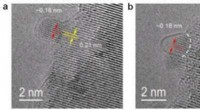
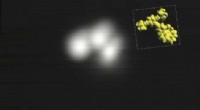
The researchers used in situ liquid cell TEM to study the growth of gold nanoparticles. They observed that the nanoparticles grew by a process called "Ostwald ripening," in which smaller nanoparticles dissolve and redeposit on larger nanoparticles. This process results in the formation of larger, more uniform nanoparticles.
The researchers also observed that the growth of gold nanoparticles was affected by the presence of impurities in the solution. For example, the presence of chloride ions slowed down the growth of the nanoparticles, while the presence of sulfate ions accelerated their growth.
The ability to observe the growth of nanomaterials in real time and at the atomic level provides valuable insights into the mechanisms by which these materials form and grow. This information can be used to design new nanomaterials with desired properties for a variety of applications, such as catalysis, energy storage, and biomedicine.
The research team's findings were published in the journal Nature Materials.