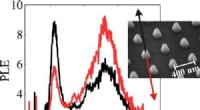
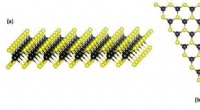
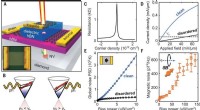
Quantum Effects: At the nanoscale, quantum effects become significant, leading to new phenomena such as quantum tunneling and quantum confinement. These effects can affect the behavior and properties of materials, requiring new approaches in device design and engineering.
Increased Surface Area to Volume Ratio: As devices become smaller, the surface area-to-volume ratio increases, making surface effects more pronounced. This can lead to increased sensitivity to surface defects and environmental factors, potentially affecting device reliability and performance.
Material Properties: The properties of materials at the nanoscale can differ significantly from their bulk counterparts. For example, metals may exhibit lower electrical conductivity, and thermal conductivity can be reduced. This requires careful selection and engineering of materials to achieve desired properties.
Challenges in Manufacturing: Fabricating nanoscale devices requires precise control over dimensions and structures, which can be challenging using conventional manufacturing techniques. This may lead to higher production costs and complexity.
Integration and Interconnection: Connecting and integrating nanoscale devices becomes increasingly complex as the dimensions shrink. This requires innovative approaches for electrical interconnects and device integration.
Reliability and Stability: Nanoscale devices may be more susceptible to environmental factors, such as temperature fluctuations, radiation, and electrostatic discharge. Ensuring reliability and stability of nanoscale devices becomes critical for long-term performance.
Despite these challenges, nanoscale electronics also offer several potential advantages, such as improved performance, increased energy efficiency, and the ability to create novel functionalities. Ongoing research and advancements in materials science, device physics, and fabrication techniques are pushing the boundaries of nanoscale electronics and exploring solutions to overcome the challenges mentioned above.