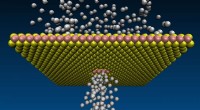
The material, a vanadium-doped transition-metal dichalcogenide, underwent a quantum transformation when subjected to carefully controlled electrical pulses, exhibiting the coexistence of two different phases of matter -- a superconducting phase and a charge order state -- that are usually mutually exclusive.
The superconducting phase is characterized by the ability to conduct electricity with zero resistance, while the charge order state exhibits a periodic arrangement of electrons. When these two states coexist, the supercurrent is modulated by the charge order, forming a modulated superconductivity phase.
The researchers hope that this discovery will lead to the realization of exotic quantum states and pave the way for novel applications in quantum computing, such as the creation of Majorana fermions, which are particles predicted to exhibit non-Abelian statistics and have potential applications in topological quantum computing.