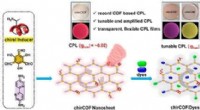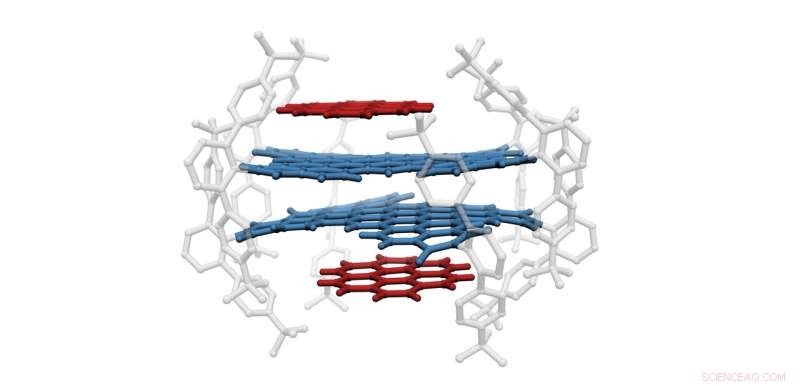
Two nanographenes (blue) with bulky substituents (gray) have each attached a PAH (red) to give a quadruple dye stack. Credit: Wuerthner group / University of Wuerzburg
Graphene is a carbon material that forms extremely thin layers. Because of its unusual properties, it is interesting for many technical applications. This also applies to polycyclic aromatic hydrocarbons (PAHs), which can be regarded as cut-outs of graphene. They are considered promising materials for organic photovoltaics or for field-effect transistors.
Large, single-layer PAH molecules—often referred to as nanographenes—are well researched. In contrast, little is known about PAHs arranged into columnar multilayer stacks.
Targeting multilayer nanographenes
Now a new approach to these materials is opening up: researchers from Julius-Maximilians-Universität Würzburg (JMU) in Bavaria, Germany, present a sophisticated method for designing precisely defined, multilayered nanographenes in the journal Nature Chemistry.
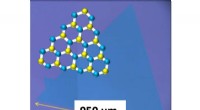
"In our lab, we have synthesized a custom-made nanographene that is equipped with two cavities on both sides of its planar core," says Professor Frank Würthner, head of the JMU Centre for Nanosystems Chemistry. The cavities are formed by the attachment of bulky substituents. As a result, the nanographene can hold a maximum of two smaller PAHs on its top and bottom sides.
In their experiments, the Würzburg chemists observed that the nanographene formed two- and three-layer PAH complexes in solution. In addition, the team was able to isolate pairs of these complexes as solids, i.e. as four- and six-layer PAHs, as well as other multilayer compounds.
The structural details of these products were confirmed by crystallographer Dr. Kazutaka Shoyama; doctoral students Magnus Mahl and M.A. Niyas accomplished the synthesis, supramolecular binding studies and quantum-chemical calculations.
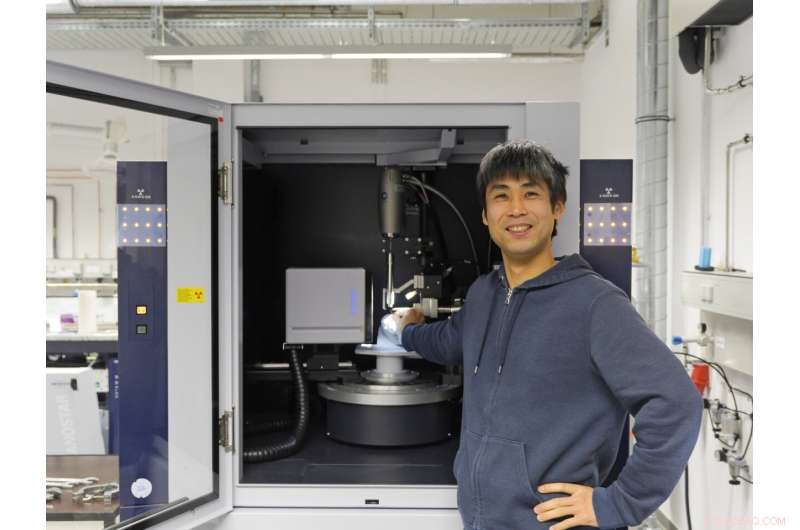
Crystallographer Dr Kazutaka Shoyama in front of his working tool, a single crystal diffractometer. Credit: Wuerthner group / University of Wuerzburg
Possible application in solar cells
"Our concept for organizing multilayer nanographenes should be applicable to the design of functional organic materials," explains Professor Würthner. He says the strategy of using multilayer nanographenes for charge carrier generation in solar cells is promising. + Explore further