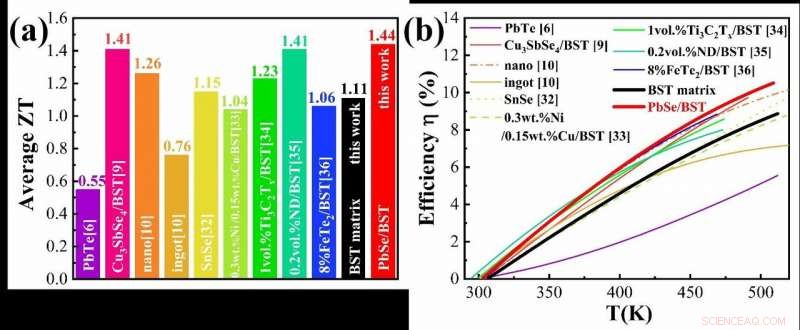
Average ZT (a) and the conversion efficiency (b) in the temperature range from 300K to 512K for the PbSe/BST composite specimen with x=0.2 vol.%. Credit: Ming Hongwei
Recently, scientists from the Institute of Solid State Physics, along with their collaborators from the Southern University of Science and Technology (SUSTech), reported high thermoelectric performance of p-type Bi0.4Sb1.6Te3 (BST), which was achieved through the scattering engineering strategy.
Thermoelectric performance is decided by conversion efficiency, which is closely related to a figure of merit, ZT. By introducing PbSe nanoparticles to the BST matrix, they regulated the scattering of majority and minority carriers and phonons. As a result, a maximum figure of merit (ZT) of 1.56 (at 400 K) and average ZTave=1.44 in the temperature range 300-512 K were reached.
Though a kind of state-of-the-art thermoelectric material, P-type alloy BiSbTe is solely used for refrigeration at near-room temperatures because its ZT would decline rapidly when the temperature increases to ~350 K.
Therefore, the scientists tried to construct proper asymmetric interface potentials in both conduction and valence bands for PbSe/BST nanocomposites, which could concurrently scatter majority and minority carriers with different strengths by introducing nanoparticles in the BST matrix.
The result also indicated that scattering engineering strategy was a prospected approach to elevate the thermoelectric performances of BST based system.