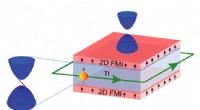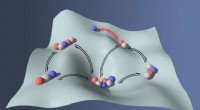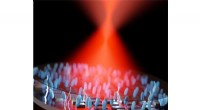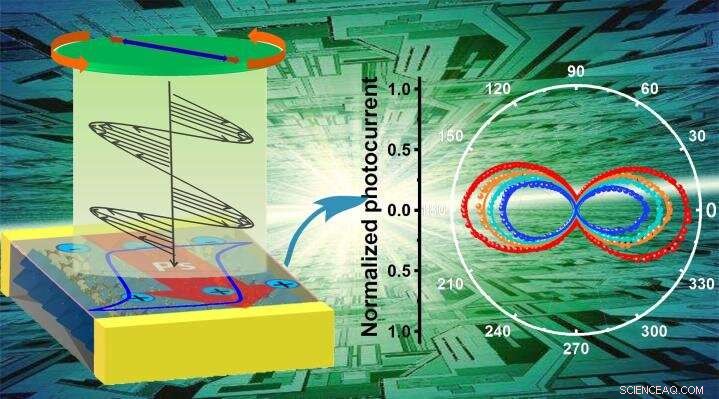
Schematic illustration of the strategy. Credit: Prof. LUO’s group
Polarized light detection plays an important role in remote sensing, near-field imaging, communication, and high resolution detectors. However, it remains a great challenge to achieve highly polarization-sensitive photodetection with large polarization ratio base on traditional semiconducting materials due to the limitation of material/device structural anisotropy.
Ferroelectric materials, characterized by switchable electric polarization, inherently feature a highly light-polarization dependent photoresponse (known as bulk photovoltaic effect, BPVE), presenting as promising alternatives in this portfolio.
In a study published in Polarized light detection plays an important role in remote sensing, near-field imaging, communication, and high resolution detectors. However, it remains a great challenge to achieve highly polarization-sensitive photodetection with large polarization ratio base on traditional semiconducting materials due to the limitation of material/device structural anisotropy.
Ferroelectric materials, characterized by switchable electric polarization, inherently feature a highly light-polarization dependent photoresponse (known as bulk photovoltaic effect, BPVE), presenting as promising alternatives in this portfolio.
In a study published in Angewandte Chemie International Edition, a research group led by Prof. LUO Junhua from Fujian Institute of Research on the Structure of Matter (FJIRSM) of the Chinese Academy of Sciences demonstrated a BPVE-driven highly efficient polarized light detection based on a two-dimensional (2-D) trilayered hybrid perovskite ferroelectric.
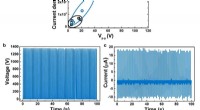
The researchers found that a polar 2-D trilayered perovskite architecture was adopted with a distinct spontaneous polarization of ~2.8 μC/cm2 and a suitable optical bandgap of ~2.71 eV. Superior BPVE was shown with a near-bandgap photovoltage of ~ 2.5 V and a high on/off switching ratio of current (~ 104).
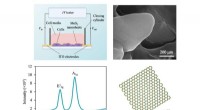
This angle-dependent photoresponse is ascribed to the inherent light-polarization dependence of superior BPVE, which arises from the optical rectification effect of ferroelectrics upon light irradiation, distinguishing from that of all the known polarized light detectors.
Besides, a polarization ratio was exhibited as high as ~15, which is far more beyond than those of reported devices based on nanowires and anisotropic 2-D materials.
This BPVE-driven polarized light detection is unprecedented, which opens up a new way towards highly efficient polarized light detection by leveraging the light-polarization dependence of the BPVE in 2-D multilayered hybrid perovskites., a research group led by Prof. Luo Junhua from Fujian Institute of Research on the Structure of Matter (FJIRSM) of the Chinese Academy of Sciences demonstrated a BPVE-driven highly efficient polarized light detection based on a two-dimensional (2-D) trilayered hybrid perovskite ferroelectric.
The researchers found that a polar 2-D trilayered perovskite architecture was adopted with a distinct spontaneous polarization of ~2.8 μC/cm2 and a suitable optical bandgap of ~2.71 eV. Superior BPVE was shown with a near-bandgap photovoltage of ~ 2.5 V and a high on/off switching ratio of current (~ 104).
This angle-dependent photoresponse is ascribed to the inherent light-polarization dependence of superior BPVE, which arises from the optical rectification effect of ferroelectrics upon light irradiation, distinguishing from that of all the known polarized light detectors.
Besides, a polarization ratio was exhibited as high as ~15, which is far more beyond than those of reported devices based on nanowires and anisotropic 2-D materials.
This BPVE-driven polarized light detection is unprecedented, which opens up a new way towards highly efficient polarized light detection by leveraging the light-polarization dependence of the BPVE in 2-D multilayered hybrid perovskites.