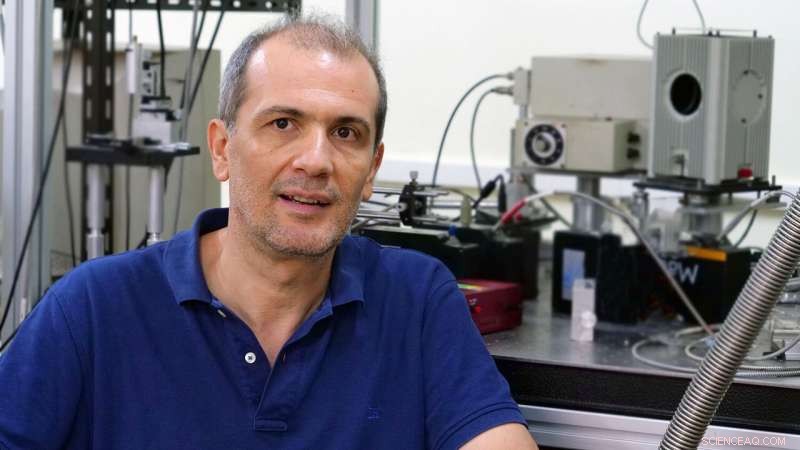
Daniel Errandonea. Credit: Valencia University
Valencia University (UV) researchers have modified the photoconductance of nanoparticles of tungsten oxide (WO3) in a controlled manner. This has potential applications in photonics and optomechanics. The results have been published in Advanced Science.
Photonductance is a well-known optical and electrical phenomenon whereby a material becomes a better electrical conductor after absorbing light. Less than a decade ago, researchers created the first materials that become less conductive after being exposed to light. This phenomenon is called inverse photoconductance (IPC). It is a photoresponsive behavior that exists in few materials, and which has potential applications in the development of photonic and non-volatile memory devices with low power consumption. The effect could also be extrapolated to create new types of sensors that can be adjusted for different spectral properties and to be directly printed on plastic substrates.
The research group of Daniel Errandonea has managed to control and modify inverse photoconductance in a hybrid material based on nanoparticles of tungsten oxide with an excess of negative charges (type n), covered by a layer of copper oxide (CuO) with an excess of positive charges (type p). They have accomplished this by subjecting the material to high pressures with a device called a diamond cell.
"From a practical point of view, what we have done is adjust the photoresponse of the WO3 nanoparticles, both in magnitude and sign, simply by modifying the crystalline structure (and consequentially the electronic properties) by applying high pressure. Depending on the applied pressure, we make it so that the material's conductivity increases or decreases with lighting," explains Errandonea.
Published in Advanced Science, the work analyses photoconductance produced by way of high pressure on WO3 nanocuboids functionalized with CuO nanoparticles. To understand the phenomenon, the researchers used a series of experimental techniques requiring the use of large synchrotron radiation installations. As a result, photoconductance was modified in a controlled and reversible way, and the origin of IPC was understood. This is a powerful tool to improve the optomechanic performance of any hybrid material. It also provides a tool to improve the performance of photovoltaic devices in the future, and through solar energy absorption, to generate energy by dividing water and breaking down organic contaminants.