Koto_feja/Getty Images
The majority of the energy we use in our daily lives comes from the sun. Plants convert solar energy into carbohydrates, animals eat the plants, and then humans eat both. Some of those plants and animals decompose into fossil fuels, which we then use to heat our homes, charge our phones, and power our cars. But what if we could cut out the middleman? Over the past few years, scientists in China have made huge strides toward that goal with the creation of an "artificial sun."
China hasn’t literally built a sun, but researchers are tapping into the nuclear process that powers the star: fusion. Unlike the fission in conventional reactors, fusion merges two light nuclei into one, releasing a massive amount of energy while producing only helium as a by‑product. This makes fusion a far cleaner energy source than fossil‑fuel combustion, which releases greenhouse gases, or fission, which generates long‑lived radioactive waste.
Controlling fusion is extremely difficult. It requires temperatures of millions of degrees and pressures that would crush any material. In the Sun’s core, hydrogen fuses at about 50–60 million degrees Fahrenheit and a pressure of 3.6 billion psi—over 200 billion times the pressure at Earth’s surface. Replicating those conditions in a laboratory is a monumental challenge, and maintaining them is even harder. That is why the recent success of China’s Institute of Plasma Physics—producing and sustaining plasma for over 1,000 seconds on January 20 , 2025—is such a milestone.
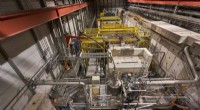
China’s breakthrough came on the Experimental Advanced Superconducting Tokamak, or EAST. While many tokamaks exist worldwide, EAST is the only one that has maintained plasma stably for such a long period. The underlying principles of a tokamak, however, are relatively straightforward.
First, containment. Because plasma is too hot for any material to survive contact, a tokamak uses a donut‑shaped magnetic field to suspend the plasma—no physical walls are needed. By spinning the plasma, its electrons align in a single direction, giving the plasma an electromagnetic charge that can be held aloft like a floating magnet.
Second, pressure. The Sun’s core pressure is enormous, but in a tokamak we rely on the ideal gas law to link temperature and pressure. EAST achieves temperatures over 180 million degrees Fahrenheit, allowing the pressure to remain comparatively low while still enabling fusion reactions.
Even though the plasma never touches the reactor walls, it still emits intense heat. The real engineering challenge is preventing that heat from melting the surrounding components. To do this, tokamak designers use high‑temperature superconductors, which conduct electricity with almost no resistance even at extreme temperatures.
While most reactors use low‑temperature superconductors that require massive cooling, EAST employs rare‑earth barium copper oxide (REBCO). REBCO eliminates the need for large cryogenic systems and improves energy efficiency—critical for a fusion reactor that must produce more energy than it consumes.
Reducing energy loss is essential for bringing fusion into the realm of practical, clean energy. Each incremental improvement, like China’s EAST tokamak, moves us closer to that goal.