Here's how it works:
1. Production: The accelerator starts by producing the particles it will use. This might involve stripping electrons from atoms to create ions, or generating particles from other sources.
2. Acceleration: The particles are then accelerated using electric and magnetic fields. These fields exert forces on the charged particles, making them move faster and faster.
3. Focusing: As the particles speed up, they are focused into a narrow beam using magnets.
4. Collision: The accelerated beam is then directed towards a target, which could be another particle beam or a stationary target. The collisions create a spray of new particles, which are then studied by detectors.
There are various types of particle accelerators, including:
* Linear accelerators: Particles are accelerated in a straight line.
* Synchrotrons: Particles are accelerated in a circular path, with the magnetic field strength increasing as the particles gain energy.
Examples of famous particle accelerators:
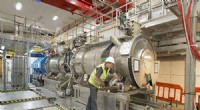
* Large Hadron Collider (LHC): The world's largest and most powerful particle accelerator, used to study the fundamental building blocks of matter.
* Stanford Linear Accelerator Center (SLAC): A linear accelerator that was used to discover the first evidence of quarks.
The collisions produced by these accelerators help physicists explore the fundamental laws of physics, study the nature of matter, and search for new particles.