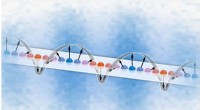
Wave motion is a fascinating phenomenon that describes the transfer of energy without the transfer of matter. Imagine a ripple spreading across a pond after you toss in a pebble. The water itself doesn't travel across the pond, but the energy from the pebble does, manifested as the wave.
Here's a breakdown of the key features:
Types of Waves:
* Mechanical Waves: These require a medium (like water, air, or a rope) to travel. Examples include sound waves, water waves, and waves on a string.
* Electromagnetic Waves: These do not require a medium and can travel through a vacuum. Examples include light, radio waves, and X-rays.
Key Characteristics:
* Amplitude: The maximum displacement of a point on a wave from its equilibrium position. Higher amplitude means more energy.
* Wavelength: The distance between two consecutive crests or troughs of a wave. It determines the color of light or the pitch of sound.
* Frequency: The number of waves that pass a fixed point in a given time. It determines the color of light or the pitch of sound.
* Period: The time it takes for one complete wave cycle to pass a point. It's the inverse of frequency.
* Velocity: The speed at which the wave travels. It's determined by the medium and the wave's properties (wavelength and frequency).
How Waves Travel:
* Transverse Waves: The particles of the medium vibrate perpendicular to the direction of wave propagation. Examples: light, water waves, and waves on a string.
* Longitudinal Waves: The particles of the medium vibrate parallel to the direction of wave propagation. Examples: sound waves, seismic waves.
Wave Interactions:
* Reflection: When a wave encounters a boundary, it can bounce back.
* Refraction: When a wave passes from one medium to another, it can change direction.
* Diffraction: When a wave passes through an opening or around an obstacle, it can spread out.
* Interference: When two or more waves meet, they can combine to create a new wave.
Applications:
Wave motion plays a crucial role in our world, with applications in:
* Communication: Radio waves, microwaves, and light waves transmit information.
* Medicine: Ultrasound and X-rays are used for diagnosis and treatment.
* Music: Sound waves create the melodies we enjoy.
* Nature: Waves shape our landscapes and influence weather patterns.
Understanding wave motion helps us grasp the fundamental workings of our universe. It's a fascinating field of study with countless applications, from the smallest particles to the vast expanse of space.