Here's why:
* Mechanical waves require a medium: These waves, like sound waves, need matter (like air, water, or solids) to oscillate and transfer energy. They rely on the interactions between particles in the medium.
* Outer space is mostly a vacuum: The vast majority of outer space is incredibly empty, with very few particles per unit volume. This means there's not enough matter to support the propagation of most traditional mechanical waves.
However, there are some exceptions:
* Plasma waves: Plasma, often called the "fourth state of matter", is a hot, ionized gas found in stars, nebulae, and solar wind. Plasma waves, a type of mechanical wave, can travel through this medium because of the interactions between charged particles.
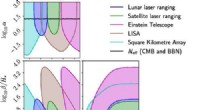
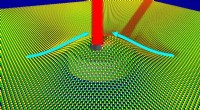
* Gravitational waves: These are not traditional mechanical waves, but they do involve the disturbance of a medium – spacetime itself. Gravitational waves are caused by massive objects accelerating, causing ripples in the fabric of spacetime that propagate at the speed of light.
So, while we don't typically think of mechanical waves in the traditional sense existing in outer space due to the lack of a dense medium, there are some specialized cases where they do exist, including plasma waves and the unique case of gravitational waves.