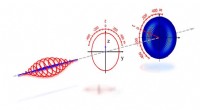
Here's a breakdown:
* Longitudinal Waves: In these waves, the particles of the medium vibrate parallel to the direction the wave travels. Imagine a slinky: when you push one end, the compression travels down the slinky, and the coils themselves move back and forth in the same direction as the compression.
Examples of Longitudinal Waves:
* Sound waves: Sound travels through air, water, or solids as a series of compressions and rarefactions (expansions) of the medium. The molecules of the medium vibrate back and forth in the same direction the sound wave is traveling.
* Seismic P-waves: These waves are generated by earthquakes and travel through the Earth's interior. They are longitudinal waves, causing the particles of the Earth to move back and forth in the direction of the wave.
Contrast with Transverse Waves:
* Transverse Waves: In these waves, the particles of the medium vibrate perpendicular to the direction the wave travels. Think of a wave on a string: the string itself moves up and down, but the wave travels horizontally.
Examples of Transverse Waves:
* Light waves: Light is a transverse electromagnetic wave, meaning the electric and magnetic fields oscillate perpendicular to the direction the light travels.
* Waves on a string: As mentioned above, these waves are a classic example of transverse waves.
Let me know if you'd like more detail on any of these types of waves!