Here's why:
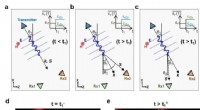
* Transverse waves vibrate perpendicular to the direction they travel. Imagine a rope tied to a wall. If you shake the rope up and down, the wave travels horizontally along the rope, but the rope itself moves up and down (perpendicular to the direction of travel).
* Longitudinal waves, on the other hand, vibrate parallel to the direction they travel. Think of a spring. If you compress and release one end, the compression travels down the spring, and the coils of the spring move back and forth (parallel to the direction of travel).
Here's a simple analogy:
* Transverse wave: Think of a wave at the beach. The water moves up and down (perpendicular), but the wave itself travels horizontally towards the shore.
* Longitudinal wave: Think of a sound wave. The air particles move back and forth (parallel) to the direction the sound travels.