While most are familiar with the four states of matter (solid, liquid, gas, plasma), there exists a fifth, less common, state: Bose-Einstein Condensate (BEC). This peculiar state emerges at extremely low temperatures, near absolute zero (-273.15°C or -459.67°F), and exhibits unique properties that blur the line between individual particles and a unified wave.
Here's a breakdown of its key characteristics:
1. From Particles to Wave:
* In a BEC, individual atoms lose their distinct identities and behave like a single, coherent wave. This is a direct result of the atoms' wave functions overlapping, essentially merging into one giant wave function.
* This phenomenon arises from the wave-particle duality of matter, meaning particles can exhibit wave-like properties under certain conditions.
2. Superfluidity and Superconductivity:
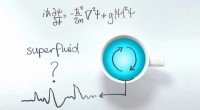
* BECs can exhibit superfluidity, meaning they flow without any friction or resistance. This allows them to flow uphill, through narrow channels, and even form vortexes (rotating rings of superfluid) without dissipating energy.
* Analogously, some BECs exhibit superconductivity, the ability to conduct electricity with zero resistance. This arises from the collective behavior of the atoms in the condensate, allowing for the free movement of electrons.
3. Ultracold Temperatures:
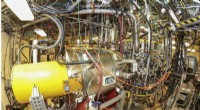
* The creation of BECs requires extremely low temperatures, typically within a few billionths of a degree above absolute zero. This is achieved through various techniques, including laser cooling and evaporative cooling.
4. Bosonic Nature:
* BECs are formed from bosons, a type of particle that follows Bose-Einstein statistics. This means that multiple bosons can occupy the same quantum state, leading to the collective behavior and wave-like characteristics observed in BECs.
5. Applications:
* Despite their extreme conditions, BECs have potential applications in various fields, including:
* Precision measurements: BECs can be used to create extremely accurate atomic clocks and sensors, allowing for precise measurements of time, gravity, and other physical phenomena.
* Quantum computing: BECs exhibit quantum properties that could be exploited for the development of quantum computers, offering faster and more efficient computation compared to classical computers.
* Material science: BECs can be used to study the behavior of matter at the atomic level, offering insights into the fundamental properties of materials.
In Summary:
The Bose-Einstein Condensate is a fascinating state of matter where individual atoms behave like a single wave, exhibiting unique properties like superfluidity and superconductivity. While it exists at extremely low temperatures, its potential applications in various fields, including quantum computing and precision measurements, make it a promising area of research.