In the context of Earth, this means:
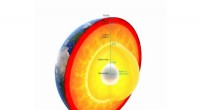
* As an object moves further away from Earth's center, the force of gravity decreases. The force gets weaker at a rate proportional to the square of the distance.
* If you double the distance from Earth's center, the force of gravity decreases to one-fourth its original value.
* If you triple the distance, the force of gravity decreases to one-ninth its original value.
This relationship is expressed mathematically as:
F = G * (m1 * m2) / r²
Where:
* F is the force of gravity
* G is the gravitational constant (a universal value)
* m1 is the mass of Earth
* m2 is the mass of the object
* r is the distance between the centers of Earth and the object
Therefore, the force of gravity weakens significantly with increasing distance from Earth's center. This is why astronauts experience weightlessness in space, as they are very far from Earth's center.