Here's a breakdown:
* What is diffraction? Diffraction is the spreading out of waves as they pass through an opening or around an obstacle. This bending of waves occurs for all types of waves, including light waves, sound waves, and water waves.
* How does it work? The Huygens-Fresnel principle explains diffraction. It states that every point on a wavefront can be considered as a source of secondary wavelets that spread out in all directions. When these wavelets interact with an obstacle, they interfere with each other, causing the wave to bend around the obstacle.
* The effect on light: Diffraction of light can cause interesting effects, such as:
* The spreading of light beams: A laser beam, for example, will spread out slightly as it travels.
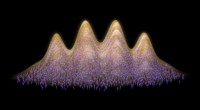
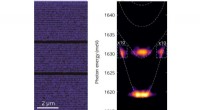
* The appearance of bright and dark bands: When light passes through a narrow slit, it creates a diffraction pattern of alternating bright and dark bands. This pattern is caused by the interference of the diffracted wavelets.
* The ability to see around corners: While light doesn't "bend" in the traditional sense, diffraction allows us to see some light around corners or obstacles. This is particularly noticeable with very narrow slits.
In summary, diffraction is a fundamental property of waves that causes them to bend around obstacles. This bending results in various effects, including the spreading of light beams and the creation of diffraction patterns.