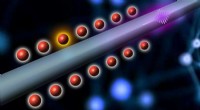
* Charged Particles and Magnetic Fields: When a charged particle (like an electron) moves through a magnetic field, it experiences a force perpendicular to both its velocity and the magnetic field direction. This force causes the electron to follow a curved path.
* Acceleration and Radiation: Since the electron is constantly changing direction, it is accelerating. According to classical electromagnetism, accelerating charged particles emit electromagnetic radiation.
* Synchrotron Radiation: This specific type of radiation produced by fast electrons moving in a magnetic field is called synchrotron radiation. It is characterized by its broad spectrum, which can range from radio waves to X-rays, depending on the energy of the electrons and the strength of the magnetic field.
Examples of Synchrotron Radiation:
* Particle Accelerators: Synchrotrons and storage rings, which are used to accelerate particles to high energies, produce synchrotron radiation as a byproduct. This radiation is often used for scientific research, such as in X-ray crystallography and materials science.
* Astrophysical Phenomena: Synchrotron radiation is also observed in space, emitted by fast electrons in the magnetic fields of nebulae, active galactic nuclei, and other celestial objects.
Key Points:
* Fast electrons moving in a magnetic field will experience a force that causes them to accelerate.
* Accelerating charged particles emit electromagnetic radiation.
* The specific type of radiation emitted by fast electrons in a magnetic field is called synchrotron radiation.