1. Understand the Concepts:
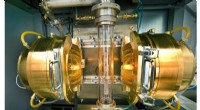
* Cyclotron: A cyclotron is a device that accelerates charged particles using a magnetic field. The particles move in a spiral path due to the magnetic force.
* Deuteron: A deuteron is the nucleus of a deuterium atom, consisting of one proton and one neutron.
* Kinetic Energy: The energy gained by the deuteron is its kinetic energy (KE).
2. Relevant Equations:
* Kinetic Energy: KE = (1/2)mv²
* Magnetic Force on a Charged Particle: F = qvB
* Centripetal Force: F = mv²/r
3. Steps to Calculate the Radius:
* Convert Energy to Joules: 15 meV = 15 × 10⁻³ eV = 15 × 10⁻³ × 1.602 × 10⁻¹⁹ J
* Find the Deuteron's Velocity:
* KE = (1/2)mv²
* v = √(2KE/m) = √(2 × 15 × 10⁻³ × 1.602 × 10⁻¹⁹ J / 3.34 × 10⁻²⁷ kg)
* Equate Magnetic Force to Centripetal Force: The magnetic force on the deuteron keeps it moving in a circular path, which is the centripetal force.
* qvB = mv²/r
* Solve for the Radius:
* r = mv / (qB) = (3.34 × 10⁻²⁷ kg × √(2 × 15 × 10⁻³ × 1.602 × 10⁻¹⁹ J / 3.34 × 10⁻²⁷ kg)) / (1.602 × 10⁻¹⁹ C × 1.5 T)
4. Calculation:
After plugging in the values and performing the calculation, you'll find that the radius (r) of the semicircle is approximately:
r ≈ 0.012 meters or 1.2 centimeters
Important Notes:
* The charge of a deuteron (q) is the same as the charge of a proton: 1.602 × 10⁻¹⁹ Coulombs.
* Make sure to use consistent units throughout the calculation.
* This calculation assumes that the deuteron is moving at a constant speed in a circular path.
Let me know if you have any other questions!