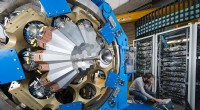
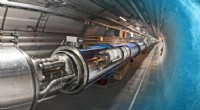
Here's how they do it:
1. Accelerating Particles: Particle accelerators use electromagnetic fields to accelerate charged particles (like protons, electrons, or ions) to very high speeds, close to the speed of light.
2. Collision Experiments: These high-energy particles are then collided with stationary targets or other beams of particles. This collision generates new particles and allows physicists to study their interactions.
3. Measuring the Results: The outcome of these collisions is measured through various detectors. These detectors record:
* The paths and energies of the resulting particles: This reveals information about the forces and particles involved in the collision.
* The types of particles produced: By analyzing the decay products of new particles, physicists can understand their properties and their interactions with other particles.
What are the key things particle accelerators can "measure" in this way?
* Fundamental particles and forces: They help us understand the building blocks of matter (quarks, leptons) and the forces that govern their interactions (strong, weak, electromagnetic, and gravitational forces).
* The structure of atoms and nuclei: They help determine the composition and properties of the nucleus, including its size, shape, and energy levels.
* New particles and phenomena: They have led to the discovery of new particles like the Higgs boson, providing insights into the origin of mass.
Overall, particle accelerators are powerful tools for:
* Testing fundamental theories: By studying the behavior of particles at high energies, we can test and refine our understanding of physics.
* Exploring the unknown: They allow us to delve into the realm of the very small, searching for new particles and phenomena that might lead to a deeper understanding of the universe.
While not directly measuring specific quantities like length or weight, particle accelerators provide invaluable insights into the nature of the universe by allowing us to explore the building blocks of matter and the fundamental forces that govern them.