* Altitude: Gravity weakens slightly as you move further away from the Earth's center.
* Latitude: Gravity is slightly stronger at the poles than at the equator due to the Earth's oblate shape.
* Local density variations: The density of the Earth's crust can also cause small fluctuations in gravity.
Here's the breakdown of why it's close to 9.8 m/s²:
* Newton's Law of Universal Gravitation: This law states that every particle in the universe attracts every other particle with a force that is directly proportional to the product of their masses and inversely proportional to the square of the distance between their centers.
* Earth's Mass and Radius: Earth has a large mass and a relatively small radius. This creates a strong gravitational pull at its surface.
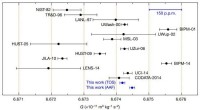
* The Value of "g": The acceleration due to gravity ("g") is calculated using Newton's law and Earth's mass and radius. This calculation gives us a value close to 9.8 m/s².
Important Note: The standard value of 9.8 m/s² is a convenient approximation used for most calculations. For more precise work, you might need to consider the specific location and altitude for a more accurate value.