* Particles and Wavelength: The ability to see an object depends on its size relative to the wavelength of light used to observe it. Light acts like a wave, and when it encounters an object smaller than its wavelength, it diffracts (bends around the object) instead of reflecting off it. This makes the object invisible.
* Visible Light and Human Vision: The human eye can detect light in the visible spectrum, which has wavelengths roughly between 400 and 700 nanometers (nm). Objects smaller than this wavelength are too small for our eyes to see.
* Microscopy to the Rescue: Microscopes use various techniques to overcome the limitations of visible light. Here are some examples:
* Light Microscopes: These magnify the object using lenses, but they still rely on visible light. To see smaller objects, they use techniques like high numerical aperture lenses to focus light more tightly and improve resolution.
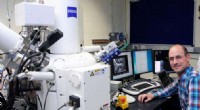
* Electron Microscopes: These use beams of electrons instead of light. Electrons have much shorter wavelengths than visible light, allowing for much higher resolution and the ability to see objects at the nanometer scale.
In Summary:
* Large Particles: Objects larger than 400 nm can be seen with the naked eye.
* Small Particles: Objects smaller than 400 nm require a microscope to be seen.
* Very Small Particles: For objects at the nanometer scale, electron microscopes are necessary.
Example:
* A human hair is about 50-100 micrometers (μm) in diameter, which is much larger than the wavelength of visible light. Therefore, you can see a human hair with your naked eye.
* A bacterium is about 1-10 μm in diameter, which is smaller than the wavelength of visible light. You need a light microscope to see a bacterium.
* A virus is about 20-400 nm in diameter, requiring an electron microscope to be visualized.