For general motion and temperature:
* Thermometer: Measures the average kinetic energy of the particles in a substance, which is directly related to temperature and therefore provides information about the average motion of the particles.
* Spectroscopy: Various spectroscopic techniques like Nuclear Magnetic Resonance (NMR) and Infrared (IR) spectroscopy can provide information about the vibrational and rotational motion of molecules.
For specific types of motion:
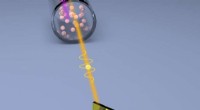
* Dynamic Light Scattering (DLS): Measures the Brownian motion of particles in a liquid or gas, providing information about particle size and diffusion coefficient.
* Atomic Force Microscopy (AFM): Can be used to image the surface of materials at the nanoscale, providing information about the motion of atoms and molecules on the surface.
* Neutron scattering: Uses neutrons to probe the motion of atoms and molecules in a material. It can provide information about the structure and dynamics of materials.
Other factors to consider:
* The state of matter: Different instruments are suitable for solids, liquids, and gases.
* The size of the particles: Microscopes are used for very small particles, while other techniques are better suited for larger particles.
* The type of motion: Techniques like NMR are specific to molecular motion, while other techniques like AFM can be used to study atomic motion.
Therefore, the instrument used to measure particle motion depends heavily on the specific application and what you want to measure.