1. Thrust:
- Newton's Third Law of Motion: The fundamental principle behind rocket propulsion is this law, which states that for every action, there is an equal and opposite reaction.
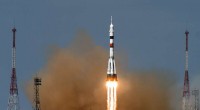
- Burning Fuel: A rocket engine burns fuel, producing hot gases that are expelled at high velocity through the nozzle.
- Thrust Force: This expulsion of gases creates a force pushing against the rocket in the opposite direction, propelling it forward. This force is called thrust.
2. Gravity:
- Downward Pull: Earth's gravity exerts a constant downward force on the rocket, working against its upward motion.
- Overcoming Gravity: The rocket's thrust must be greater than the force of gravity to achieve liftoff and continue accelerating upwards.
3. Air Resistance:
- Friction: As the rocket travels through the atmosphere, it experiences air resistance, which is a force opposing its motion.
- Drag: This frictional force is known as drag and increases with the rocket's speed and the density of the air.
- Aerodynamic Design: Rockets are designed with streamlined shapes to minimize drag and improve efficiency.
4. Acceleration:
- Newton's Second Law of Motion: This law states that the acceleration of an object is directly proportional to the net force acting on it and inversely proportional to its mass.
- Net Force: The net force acting on a rocket is the difference between the thrust force and the sum of gravity and air resistance forces.
- Acceleration: The rocket accelerates according to the net force and its mass.
5. Trajectory:
- Steering: Rockets have guidance systems that control the direction of the thrust force, allowing them to steer and follow a desired trajectory.
- Gravity and Air Resistance: Gravity and air resistance also influence the rocket's trajectory, and engineers must account for these factors when designing flight paths.
In Summary:
Force is the driving factor behind rocket operation, allowing them to overcome gravity, air resistance, and accelerate to incredible speeds. The interplay of thrust, gravity, air resistance, and steering forces determines a rocket's motion and ultimately its success in reaching its destination.