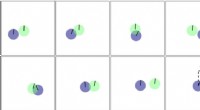
1. Increased Collision Frequency:
- Faster particles move around more rapidly and collide with each other more frequently.
- More collisions mean more chances for the reacting particles to come into contact and potentially react.
2. Higher Collision Energy:
- The kinetic energy of a particle is directly proportional to its velocity.
- Faster particles possess more kinetic energy, leading to more forceful collisions.
- These collisions are more likely to overcome the activation energy barrier, which is the minimum energy required for a reaction to occur.
3. Greater Probability of Successful Collisions:
- Even if particles collide, they don't always react.
- Successful collisions require the particles to collide with the correct orientation and sufficient energy.
- Faster particles have a greater chance of achieving the proper orientation and overcoming the activation energy barrier during collision.
In summary:
- Faster particles collide more often.
- They collide with greater energy, increasing the likelihood of overcoming the activation energy.
- This leads to a higher probability of successful collisions and, therefore, a faster reaction rate.
Important note: While increased temperature leads to faster particle movement and a faster reaction rate, it's not the only factor affecting reaction rates. Other factors like concentration, surface area, and the presence of catalysts also play a significant role.