1. Heat Energy and Vibrations:
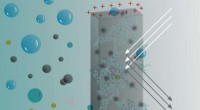
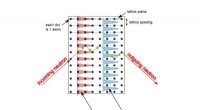
* When a substance absorbs heat, its atoms gain kinetic energy. This energy is not used to move the atom to a new location, but rather to increase its *vibrational* motion. Think of the atoms as tiny balls bouncing around in a fixed position.
* The more heat energy an atom absorbs, the faster it vibrates.
2. Collisions and Energy Transfer:
* The vibrating atoms collide with their neighboring atoms.
* During these collisions, some of the kinetic energy of the vibrating atom is transferred to its neighbor.
* This neighbor now vibrates more vigorously, and the process continues.
3. Heat Transfer:
* The transfer of kinetic energy from atom to atom through collisions is what constitutes heat conduction.
* The process continues until the energy is evenly distributed throughout the material, leading to a temperature equilibrium.
Example:
Imagine a metal rod with one end heated. The heated end's atoms vibrate more rapidly. These vibrations spread through the rod as they collide with neighboring atoms, transferring their energy. This results in the whole rod eventually reaching a higher temperature.
Key Points:
* Atoms don't move to new locations during conduction. They simply vibrate more vigorously.
* Conduction is most efficient in materials with closely packed atoms and strong bonds. This allows for efficient energy transfer through collisions.
* The rate of conduction depends on the material's thermal conductivity. Some materials, like metals, conduct heat very well, while others, like wood, conduct heat poorly.
I hope this explanation helps!